
What Is An Anterior Ankle Impingement?
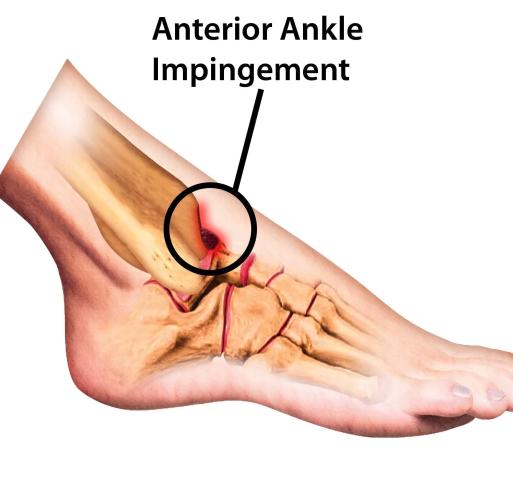
Anterior ankle impingement occurs when the joint capsule at the front of the ankle becomes pinched, compressed, or wedged as you move your foot upwards (toes towards the sky). This results in pain, swelling, limited range of motion, a locking sensation, and potential weakness around the foot and ankle.
Want this looked at? Our podiatrists can assess it and give you a clear plan.
How An Anterior Ankle Impingement Develops
To understand anterior ankle impingement, imagine your foot moving upwards on your ankle. The tibia (shin bone) and fibula in your lower leg rest above the talus bone, which acts as a hinge when you point your toes up.
When your foot is pointed down, there’s a larger gap between the tibia and talus. As you point your toes upward, the talus moves closer to the tibia, compressing structures at the front of the ankle, which can irritate the joint capsule. Other contributing factors include:
- An irregular bone shape at the front of the talus
- Foot biomechanics
- Bone spurs at the front of the ankle
- Calcification from past injuries, like an ankle sprain
- Swelling narrowing the joint space
- A cyst or other growth in the area
Typically, this condition results from how we move our feet during physical activities and sports, or injuries sustained during these activities. Common causes include:
- Dancing
- Soccer, rugby, and ball sports
- Uphill running
- Tripping and falling with the foot planted
- Ankle sprains
- Squatting
- Jumping sports
Anterior Ankle Impingement affecting you?
You can book without a referral. If your GP has given you a care plan, bring it along and we’ll claim your Medicare rebate for you on the day.
Ask us about anterior Ankle Impingement
Not ready to book? Send us a message and our team will get back to you.
This page is general information only and isn’t a substitute for an assessment. If your symptoms are severe or getting worse, see a podiatrist or your GP. Browse all conditions we treat.